Workstation technical brief: why Rust remains a strong default for many modern applications — APIs, edge, agents, and CI/CD platforms — and how to place CPU-bound work correctly beside an async runtime. We draw inspiration (not a verbatim reprint) from Alice Ryhl’s essay Async: What is blocking?, especially the Rayon guidance. Companion: blog · evidence: Polyglot Benchmarks · related: polyglot article.
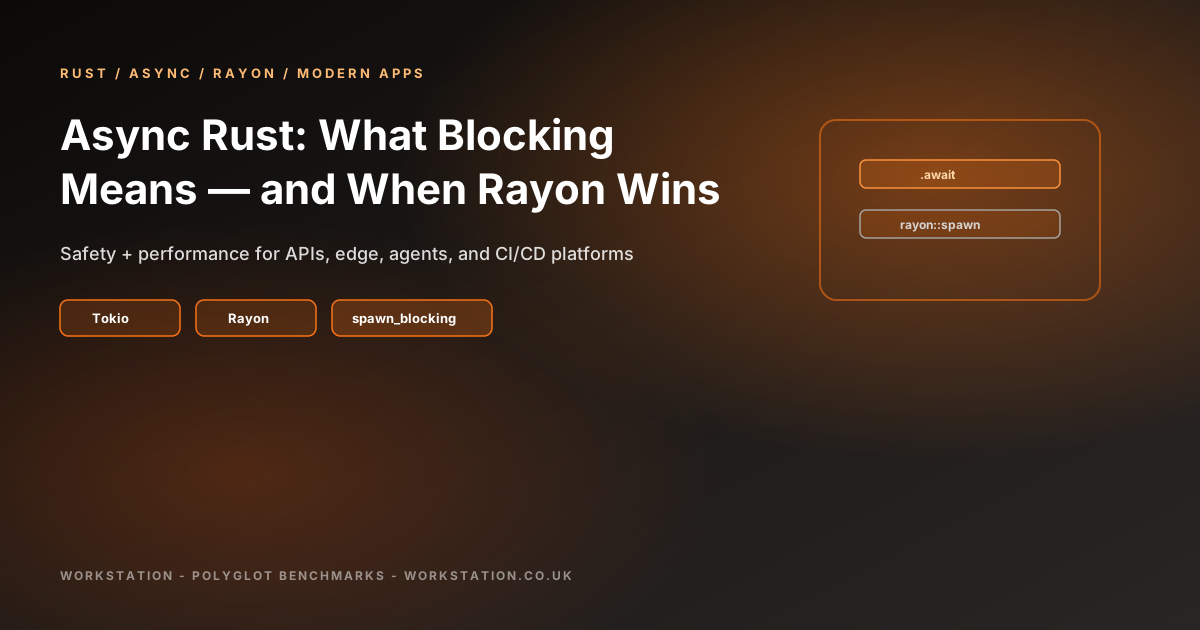
- Blocking (async sense): preventing the runtime from swapping tasks — usually by spending a long time without
.await. - CPU-bound fix: prefer Rayon (or a dedicated thread) over stuffing heavy compute onto Tokio workers.
- IO-bound sync libraries:
tokio::task::spawn_blockingis usually the right pool. - Polyglot: Rust is one strong tool among peers — measure with Polyglot Benchmarks before mandating a stack.
- Credit: conceptual framing inspired by Alice Ryhl / ryhl.io; Workstation applies it to platform engineering.
1. Rust benefits that matter in production estates
Modern application portfolios are rarely monolingual. Still, certain surfaces reward Rust’s properties:
- Memory safety without GC jitter — ownership and borrowing catch use-after-free and data races at compile time; latency-sensitive paths avoid stop-the-world pauses.
- Predictable performance — zero-cost abstractions and fine control over allocation make Rust competitive for hot API paths and edge transforms.
- Fearless concurrency (with structure) — Send/Sync and async ecosystems (Tokio, async-trait patterns, channels) encourage designs that scale under fan-out.
- Deployable binaries — single static-ish artifacts simplify containers for gateways, agents, and CI/CD sidecars.
- Interop in polyglot estates — FFI, Wasm, and HTTP keep Rust next to Go, Python, JVM, and Lua edges without forcing a rewrite of everything.
Workstation’s stance matches our Polyglot Benchmarks blog and long article: choose the right tool for the bounded context. On the live dashboard at polyglot-benchmarks.fictionally.org, Rust (Actix in that harness) frequently shows strength on CPU-bound and concurrency-sensitive HTTP rows — useful evidence when an ADR argues for Rust on a hot path, not a religion.
2. Cooperative scheduling: the meaning of “blocking”
Async Rust uses cooperative scheduling. The runtime swaps tasks when they reach an .await. Alice Ryhl’s memorable rule applies everywhere we ship async services:
Async code should never spend a long time without reaching an .await.
In this vocabulary, “blocking the thread” does not merely mean “doing IO.” It means preventing the runtime from swapping the current task. Classic footguns:
std::thread::sleepinside an async fn (no await — timers run serially underjoin!).- Heavy loops, compression, crypto, vector math, or JSON-on-steroids on a Tokio worker.
- Holding a sync mutex across a long critical section on the async pool (short locks can be fine; long ones are not).
On a multi-threaded runtime you can hide the bug until you saturate worker threads. Production traffic finds it for you. For latency SLOs, treat tens-to-hundreds of microseconds between awaits as the budget for cooperative work; anything longer belongs off the async pool.
3. Three places to put work that must block
When you intentionally need to block — expensive CPU or sync IO — move that work off Tokio’s scheduler threads. The cheat sheet (aligned with Ryhl’s framing):
| Approach | CPU-bound | Sync IO | Runs forever |
|---|---|---|---|
spawn_blocking | Suboptimal (large pool) | OK | No |
| Rayon | OK | No | No |
Dedicated std::thread | OK | OK | OK |
3.1 spawn_blocking for sync IO
tokio::task::spawn_blocking schedules onto Tokio’s blocking pool (hundreds of threads by default). That suits filesystem calls and blocking database drivers. It is a poor fit for sustained CPU because oversubscription fights the OS scheduler — fine for a few short computations, risky as a default for parallel crunching.
3.2 Rayon for expensive CPU
Rayon maintains a pool sized for CPU-bound parallelism. The critical integration detail: do not block a Tokio worker waiting for Rayon. Spawn on Rayon, send the result through tokio::sync::oneshot, and .await the receiver on the async side. Parallel iterators (par_iter) still need that outer rayon::spawn because they block until complete.
// Shape only — see ryhl.io for a full walkthrough
async fn parallel_work(data: Vec<i32>) -> i32 {
    let (tx, rx) = tokio::sync::oneshot::channel();
    rayon::spawn(move || {
        let sum: i32 = data.into_iter().sum(); // or par_iter inside
        let _ = tx.send(sum);
    });
    rx.await.expect("rayon task panicked")
}
Credit: this integration pattern is the heart of the Rayon crate section on ryhl.io. Workstation recommends the same shape inside product services so request threads stay schedulable.
3.3 Dedicated threads for forever work
A loop that never exits (dedicated DB connection owner, long-lived bridge) should not consume a slot from either pool permanently. Prefer std::thread::spawn and communicate via channels.
4. Mapping the advice onto modern application types
| Surface | Keep on async | Offload |
|---|---|---|
| APIs | Accept, authn, fan-out HTTP, streaming | Heavy serialization, crypto batches, scoring |
| Edge / gateways | Routing, cache lookup, WAF decisions | Rare CPU transforms; prefer Lua/njs when measured better |
| Agents | Tool orchestration, MCP sessions, timeouts | Embedding prep, eval suites, large local transforms |
| CI/CD platforms | Promote APIs, health polls, UI/API | Deep artifact analysis, bulk verification |
Workstation products illustrate the split: Ring Promoter must keep promotion and health gates snappy; WSL Proxy keeps edge paths free; KubePilot needs responsive incident loops even when analysis is heavy. Rust (or Go, or Lua) is chosen per surface after measurement — never because a hallway debate declared a winner.
5. Architecture checklist for teams adopting async Rust
- Inventory await gaps: profilers and tracing spans that never yield.
- Classify blocking work: sync IO vs CPU vs forever-loop.
- Pick the pool:
spawn_blocking, Rayon + oneshot, or dedicated thread. - Load-test with realistic concurrency — multi-threaded runtimes hide bugs at N=1.
- Document the decision in an ADR; attach Polyglot Benchmarks rows when language choice is in play.
- Re-read Tokio guidance on shared state and cooperative yielding for tail latency.
6. Further reading
- Alice Ryhl — Async: What is blocking? (primary inspiration for the Rayon / spawn_blocking framing).
- Workstation — Polyglot Benchmarks live dashboard.
- Workstation — Polyglot blog · Polyglot article.
- Workstation — companion blog for a skim version of this brief.
Published by Workstation. Conceptual credit to Alice Ryhl’s public writing on async blocking and Rayon; all product framing and polyglot guidance are Workstation’s.