
Rust Async Blocking, Rayon & Modern Applications
What “blocking” means in async Rust, when Rayon fits CPU-bound work, and why Rust stays strong for APIs, edge, agents, and CI/CD platforms
 Balinder WaliaAugust 26, 20263 min read
Workstation on why Rust stays a first-class choice for modern applications — and what “blocking” really means when you mix Tokio with CPU-heavy work. Inspired by Alice Ryhl’s Async: What is blocking? (Rayon section). Deep dive: long article.
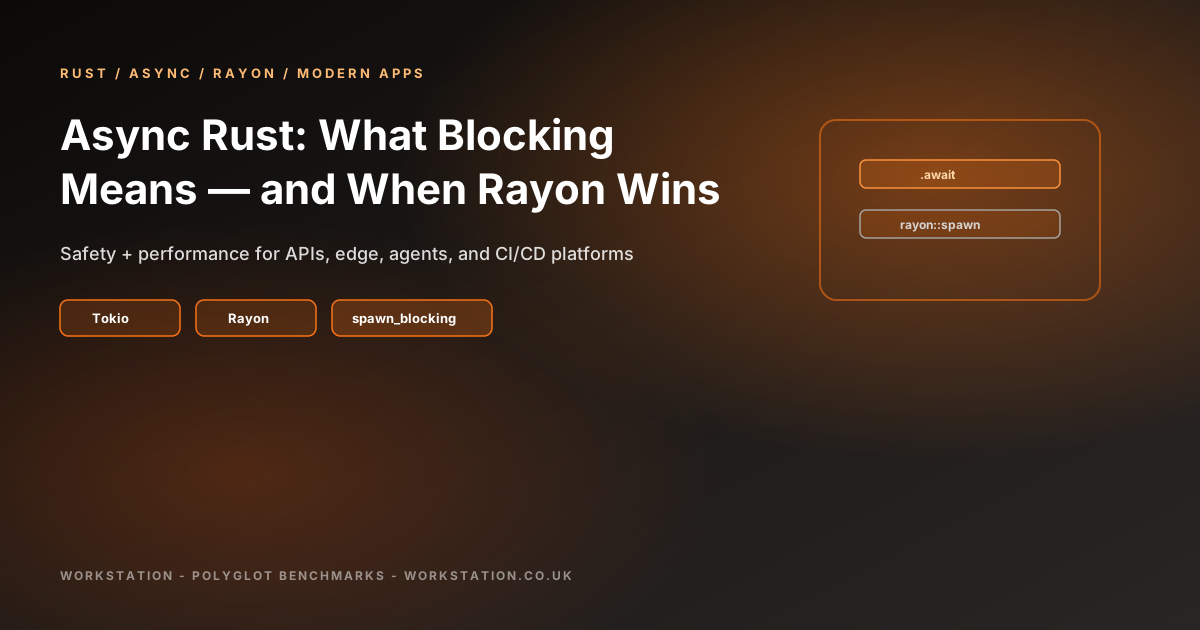
.await long enough that other tasks starve. Move expensive CPU work off Tokio’s pool — often with Rayon plus a oneshot channel — and keep the async path responsive for APIs, edge proxies, agents, and CI/CD control planes.
Why Rust keeps winning modern application slots
Teams pick Rust when they need memory safety without a GC pause tax, predictable latency under load, and concurrency that the type system helps you get right. That combination shows up everywhere Workstation builds: high-throughput APIs, edge gateways, agent runtimes, and promotion control planes that cannot freeze when a spike of CPU work arrives.
It is not “Rust for everything.” Our Polyglot Benchmarks dashboard and companion posts — blog / article — compare Rust with Go, Bun, JVM stacks, and scripting edges on the same HTTP workloads. Rust often leads on CPU-bound and concurrency-heavy rows; other runtimes win on velocity or edge transforms. The point is evidence, then ADRs.
What “blocking” means in async Rust
Async runtimes (Tokio and friends) swap tasks at .await points. If your task burns milliseconds of CPU or sleeps with std::thread::sleep without awaiting, the worker cannot schedule anyone else on that thread. Locally you might not notice (a few cores hide the bug); in production you run out of workers and latency tails explode.
Rule of thumb from the ecosystem: stay within tens to hundreds of microseconds between awaits for latency-sensitive services — and treat anything longer as work that belongs elsewhere.
When Rayon helps (CPU-bound)
- spawn_blocking — Tokio’s blocking pool: great for sync IO (filesystem, blocking DB drivers); suboptimal for heavy CPU because it can oversubscribe cores.
- Rayon — a small, CPU-sized thread pool for parallel iterators and expensive computations. Bridge with
rayon::spawn+tokio::sync::oneshotso the async task awaits the result without blocking the runtime thread. - Dedicated thread — for forever-loops (connection managers, long-lived workers) that must not permanently consume pool capacity.
That Rayon + oneshot pattern is exactly what Alice Ryhl walks through in the Rayon section — Workstation’s take is how those choices land in polyglot estates shipping agents and platforms, not a reprint of the tutorial.
Where this shows up in Workstation products
- APIs and edge — keep request workers free for IO; fan CPU transforms onto Rayon when a hot path needs it.
- Agents — embedding prep, eval batches, and tool-side crunch should not stall the orchestration loop.
- CI/CD platforms — health checks and promotion engines (see Ring Promoter) stay responsive while heavier verification work runs off-pool.
- Kubernetes ops — incident copilots like KubePilot need snappy control loops even when analysis is CPU-heavy.
Read next
- Long article — cheat sheet, code-shaped patterns, and architecture notes.
- polyglot-benchmarks.fictionally.org — live Rust vs peers evidence.
- Alice Ryhl — Async: What is blocking?
Published by Workstation.