AI Knowledge Base · Private AI Data Centres
Private AI for law and accounting firms
Client confidentiality is not a setting you can switch on in someone else's cloud. This guide is for law firms and accountancy practices that want the productivity of AI while keeping privileged and financial data under their own control: on their premises, in a private data centre, or in a cloud locked down so tightly that it behaves like one.
- Law firms
- Accountancy practices
- On-premises
- Private data centre
- पूरी तरह सुरक्षित क्लाउड
Why cloud may not be an option
Professional firms hold the data that clients trust them with most. Before any of it reaches an AI model, the firm has to be able to answer: where is it processed, who can see it, how long is it kept, and can we prove it?
Professional duties
Solicitors must keep clients' affairs confidential under the SRA Code of Conduct, and legal professional privilege must not be put at risk. Confidentiality is a fundamental principle of the ICAEW and ACCA codes of ethics for accountants.
Data protection law
UK GDPR requires appropriate security, a lawful basis, and safeguards for any transfer outside the UK. AI processing of client data usually needs a data protection impact assessment (DPIA).
Client and insurer demands
Outside-counsel guidelines, panel questionnaires, audit clients and cyber insurers increasingly ask exactly where documents are processed and whether they train any model.
Financial and AML records
Accountants hold tax, payroll and anti-money-laundering records that carry their own retention and confidentiality obligations.
A favoured target
Law and accountancy firms are attractive to ransomware and fraud groups because they hold valuable data and work to deadlines. The NCSC has published threat guidance specifically for the legal sector.
Information barriers
Ethical walls between matters and clients must survive inside the AI too: a firm-wide index that ignores them can create a conflict.
Deployment options, from most to least isolated
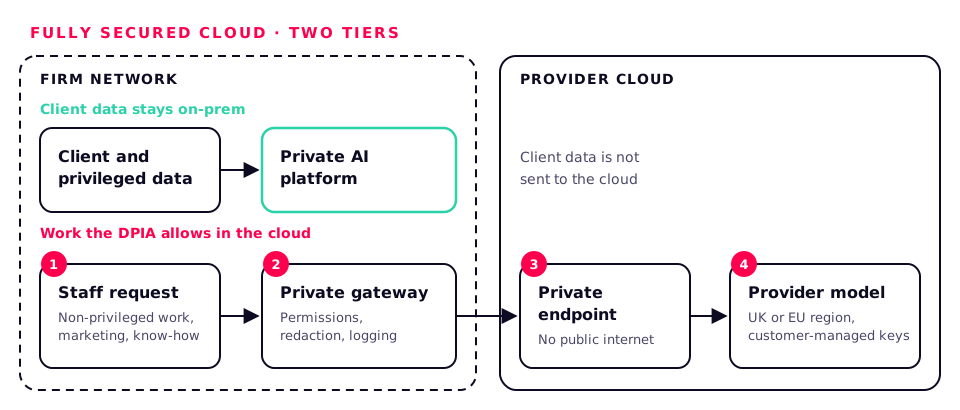
There is a spectrum between a machine with no network connection and a public AI service. Most firms end up with two tiers: a private platform for client data, and tightly controlled cloud for everything else.
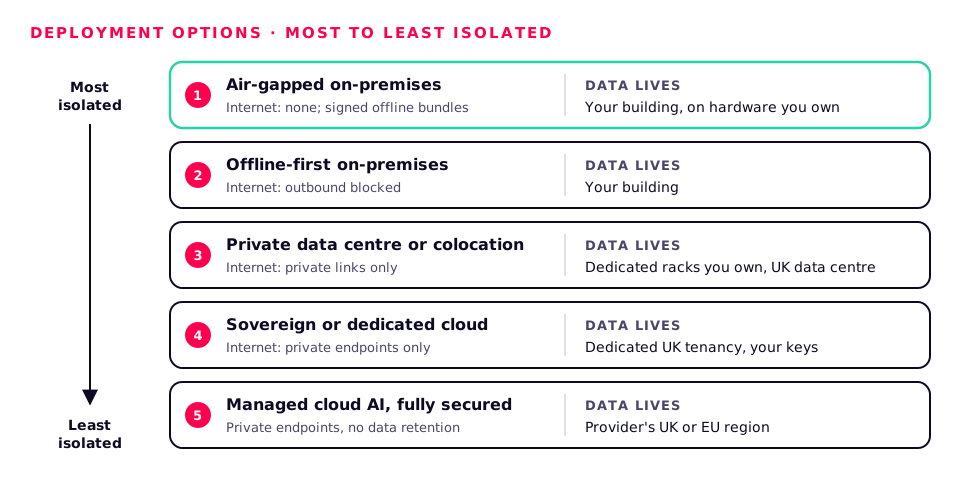
| Option | Where data lives | Internet | इनके लिए सर्वोत्तम | Trade-offs |
|---|---|---|---|---|
| Air-gapped on-premises | Your building, on hardware you own | None; updates by signed offline bundles | Highest-sensitivity matters, litigation, disclosure | Manual update process; capacity fixed by hardware |
| Offline-first on-premises | Your building | Outbound blocked; controlled update window | Most firms' private AI platform | Needs a patching routine and local support |
| Private data centre or colocation | Dedicated racks you own in a UK data centre | Private links only | Multi-office firms, firm-wide AI, shared services | Contracts, cross-connects and remote hands |
| Sovereign or dedicated cloud | Dedicated tenancy in a UK region, your keys | Private endpoints only | Burst capacity, firms without server rooms | Provider trust and exit planning |
| Managed cloud AI, fully secured | Provider's UK or EU region | Private endpoints, no data retention | Non-privileged work, marketing, internal knowledge | Provider processes the data, even if briefly |
Use cases for law firms
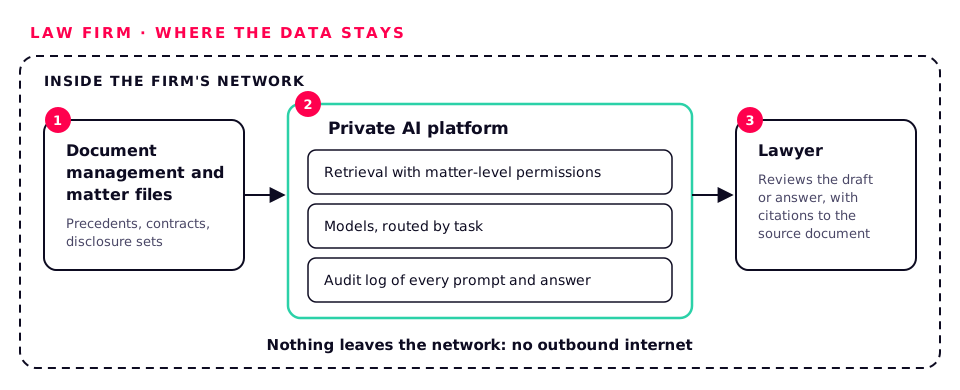
Disclosure and document review
Classify, summarise and prioritise large disclosure sets, with every answer linked back to the source document.
Contract analysis
Extract clauses, compare against the firm's standard positions and flag unusual terms across hundreds of agreements.
Due diligence
Work through data rooms quickly, building issue lists and red-flag reports with citations.
Know-how and research
Ask questions of the firm's own precedents, opinions and practice notes, respecting matter-level permissions.
First drafts
Draft letters, attendance notes and standard documents from the firm's templates for a lawyer to review.
Dictation and transcription
Local speech-to-text for dictation, interviews and hearings, with no audio leaving the building.
Matter summaries
Chronologies, case summaries and handover notes generated from the matter file.
Time narratives
Suggest time-entry narratives from activity, reviewed by the fee earner before submission.
Use cases for accounting firms
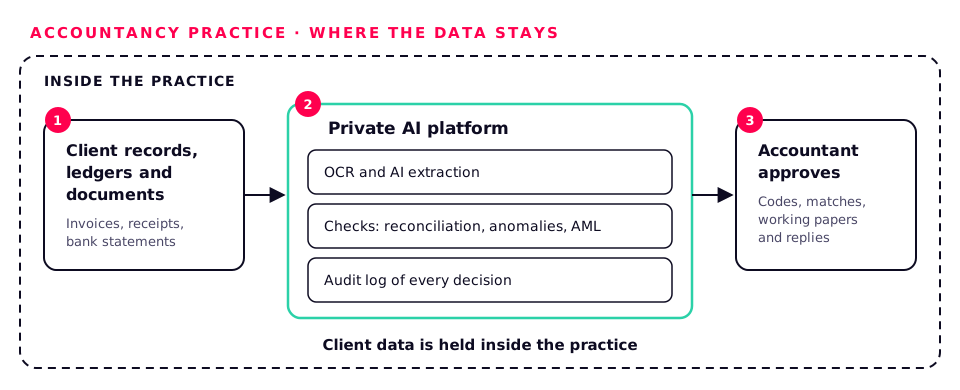
Document capture
Read invoices, receipts, bank statements and payslips (OCR plus AI extraction) straight into the ledger workflow.
Categorisation and reconciliation
Suggest nominal codes and match transactions, learning each client's patterns, with an accountant approving.
Audit analytics
Test whole populations instead of samples, flag anomalies, duplicates and unusual journals for review.
Tax research and preparation
Answer questions from the firm's tax library and prepare working papers for review, never filing on its own.
Client queries
Draft replies to routine client questions from their own records, held inside the practice.
Accounts and notes
Draft management commentary and disclosure notes from trial balances and prior-year files.
AML and KYC checks
Read and check identity and source-of-funds documents, with every decision logged.
Forecasting
Cash-flow and scenario models built from the client's own data, run privately.
What a professional-grade private AI platform includes
These are the capabilities we build into private AI for law and accounting firms. Each one exists because a partner, a client, a regulator or an insurer has asked for it.
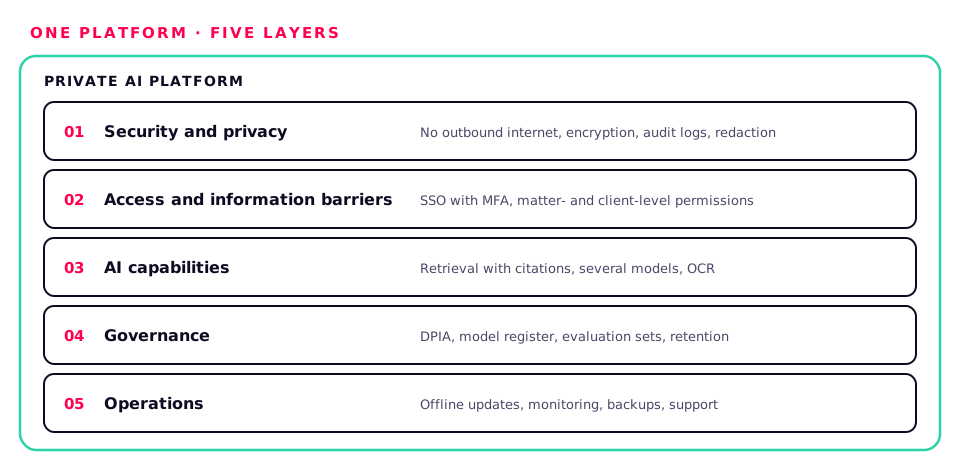
01
Security and privacy
- No outbound internet: default-deny egress, proven by a 24-hour packet-logging test before handover
- Full-disk encryption (LUKS2) sealed to the TPM, with unattended restart and a sealed recovery key
- UEFI Secure Boot with signed drivers; firmware passwords and locked boot order
- Confidential computing on supported GPUs and CPUs (NVIDIA confidential computing, AMD SEV-SNP, Intel TDX) where data must be protected even from administrators
- Mutual TLS between services; keys in an HSM or vault
- Own network segment: staff reach one HTTPS port, nothing reaches back
- Immutable, append-only audit logs of every prompt, document and answer, exportable to your SIEM
- PII and secret redaction before anything is logged or indexed
02
Access and information barriers
- Single sign-on with MFA through your identity provider
- Role- and attribute-based access, mirrored from the document management system
- Matter- and client-level permissions enforced at query time, so ethical walls hold inside the AI
- Per-user and per-matter usage reports for partners and compliance
03
AI capabilities
- Retrieval over your document management, practice and accounting systems through their APIs, with source citations on every answer
- Several models side by side, routed by task: small and fast for classification, large for drafting and reasoning
- Fine-tuning on the firm's own precedents and style (LoRA), kept on your hardware
- Local speech-to-text, OCR for scanned bundles and translation
- Agent workflows with human approval before anything leaves a draft state
- Grounding checks and 'I don't know' behaviour instead of invented answers
04
Governance
- An AI usage policy and DPIA prepared with you
- Model register: which models, versions and licences are in use, and for what
- Evaluation sets built from the firm's own work, re-run before every model change
- Retention aligned with matter retention and legal hold
- Reports ready for client audits, panel reviews and insurers
05
Operations
- Signed, verified offline update bundles for the OS, containers and models
- Monitoring of GPU health, latency and usage, alerting your IT team or ours
- Encrypted, offline backups (3-2-1-1-0) and tested bare-metal recovery
- 72-hour burn-in and a handover pack with every test result
- Support and patching agreements sized to the firm
When cloud is acceptable: fully secured options from the major providers
For some work, a properly locked-down cloud service is acceptable, and it adds capacity on demand. These are the controls we insist on, by provider. Your DPIA and client terms decide what may go where.

Microsoft Azure (Azure OpenAI, AI Foundry)
- Customer data not used to train models
- Private endpoints and network isolation
- Customer-managed keys
- UK South and UK West regions; EU Data Boundary for EU offices
- Modified abuse monitoring for eligible customers, so prompts are not retained for review
- Entra ID with Conditional Access

Amazon Web Services (Amazon Bedrock)
- Prompts and outputs not used to train base models or shared with model providers
- PrivateLink VPC endpoints, no internet path
- KMS customer-managed keys
- London region
- Guardrails for PII redaction and content control
- CloudTrail logging of every call

Google Cloud (Vertex AI)
- Customer data not used to train models
- Zero data retention configuration for supported models
- VPC Service Controls perimeter and CMEK
- London region and data residency controls
- Access Transparency and Access Approval for provider access
- Model Armor for prompt and response screening

Oracle Cloud (OCI Generative AI)
- Dedicated AI clusters for isolated model hosting
- Customer-managed keys in OCI Vault
- London and Newport (Wales) regions
- Private service access
We pair any cloud use with a private gateway that enforces the firm's permissions, redacts identifiers and logs every request before it leaves your network.
On-premises and private data centre AI platforms
We are vendor-neutral and build on the platforms that suit each firm, from a single workstation to a private AI data centre.
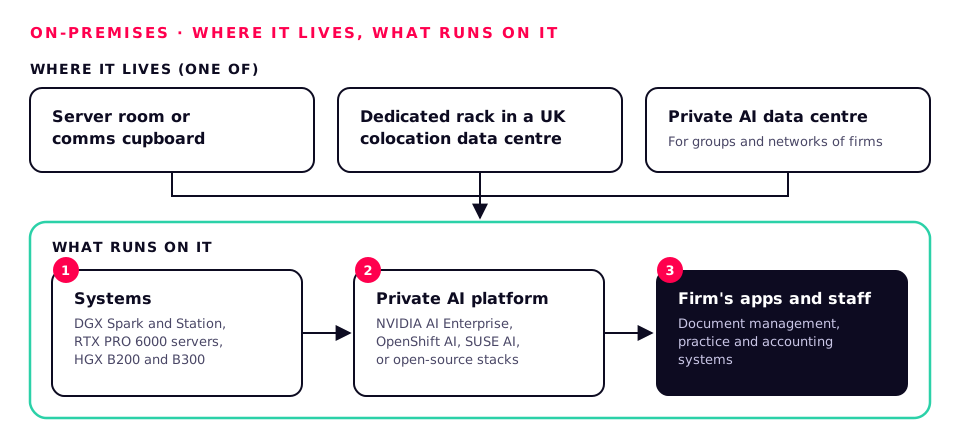
Systems
- NVIDIA DGX Spark and DGX Station for desk-side and small-team AI
- Workstation towers and 4U servers with NVIDIA RTX PRO 6000 Blackwell (96 GB per GPU)
- NVIDIA HGX B200 and B300 8-GPU servers for firm-wide platforms
- OEM AI servers from Dell (PowerEdge XE), HPE, Lenovo (ThinkSystem) and Supermicro
Private AI platforms
- NVIDIA AI Enterprise and NIM microservices, licensed for on-premises use
- Dell AI Factory with NVIDIA and HPE Private Cloud AI as turnkey stacks
- Red Hat OpenShift AI and SUSE AI on Kubernetes
- VMware Private AI Foundation with NVIDIA for VMware estates
- Nutanix Enterprise AI for hyperconverged environments
- Open-source stacks: vLLM, Open WebUI, pgvector and Qdrant, on Ubuntu or RHEL
Where it lives
- A server room or comms cupboard, with the right power and cooling
- A dedicated rack in a UK colocation data centre
- A private AI data centre for groups and networks of firms
Sizing by firm size
Indicative starting points. Every proposal is confirmed with your own documents, models and user numbers.
| Firm | Concurrent users | Typical platform | Models |
|---|---|---|---|
| Sole practitioner or small practice | Up to ~10 | Workstation with a 24–32 GB RTX PRO GPU | 8–14B models |
| Small to mid-sized firm | ~25 | Workstation or server with a 48 GB GPU | Up to ~32B models |
| Mid-sized firm, busy department | 25–50 | Server with a 96 GB RTX PRO 6000 | 70B models at 4-bit |
| Large firm, multiple offices | Hundreds | Rack of 8-GPU servers plus all-NVMe storage | Several large models at once |
| Firm networks and groups | Thousands | Private AI data centre with HGX B200/B300 | Frontier-scale and fine-tuned models |
Compliance mapping
Technology doesn't make a firm compliant, but it should make compliance easy to show. This is how the platform supports the frameworks firms ask about.
UK GDPR and the Data Protection Act 2018
Data stays in the UK, processing is documented, access is logged, and we help prepare the DPIA.
SRA Standards and Regulations
Confidentiality and information barriers enforced in software, with evidence for supervision and audits.
ICAEW and ACCA codes of ethics
Confidentiality of client information, with records of who accessed what and why.
ISO/IEC 27001
Controls for access, cryptography, operations, logging and supplier management map directly to the platform.
Cyber Essentials Plus
Firewalls, secure configuration, patching, access control and malware protection built in.
EU AI Act
For EU offices: transparency, human oversight and record-keeping supported by design.
How to start

- 1Discovery
A confidential conversation under NDA about your work, data and risk appetite.
- 2Pilot
A desk-side system or a small server running your own documents in your building.
- 3Prove it
Measured results on real matters or client files, plus the security tests and DPIA.
- 4Scale
Firm-wide platform, private data centre or hybrid, with support and training.
Microsoft Azure, Amazon Web Services, Google Cloud and Oracle Cloud names and logos are trademarks of their respective owners, shown only to identify their products.